Key outcomes
Global review calls for accelerated implementation
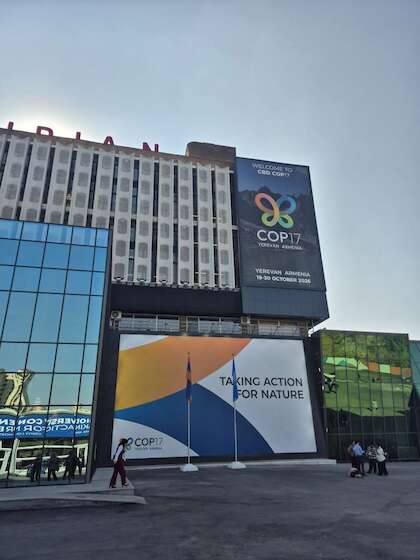
The review also highlighted significant challenges around finance and the need to address the underlying drivers of biodiversity loss. These include reforming incentives and subsidies harmful to biodiversity and integrating biodiversity considerations across economic sectors.
In response, Parties adopted the Yerevan Pathway, addressing the gaps and setting out priorities to accelerate GBF implementation and ‘course-correction’ through 2030. Key topics include tackling subsidies and incentives harmful to biodiversity, scaling up financial, scientific and technical support, aligning national budgets and economic decisions with the GBF, and strengthening monitoring and reporting.
Mainstreaming biodiversity across business and economic sectors
COP17 highlighted the importance of mainstreaming biodiversity across economic sectors and addressing the underlying drivers of biodiversity loss. For business, this increases the focus on how global biodiversity goals can be translated into practical sectoral transition pathways and actions.
Discussions also drew on recent Intergovernmental Science-Policy Platform on Biodiversity and Ecosystem Services (IPBES) work on the interconnections between biodiversity, climate, water, food and health and on the changes needed to address biodiversity loss. However, negotiations demonstrated that challenges remain in achieving consensus between parties on the language used, scale, and nature of economic and societal change.
Reforming subsidies harmful to biodiversity
Progress on GBF Target 18 remains a significant challenge. The target calls for countries to identify harmful incentives by 2025 and eliminate, phase out or reform incentives, including subsidies, harmful to biodiversity, reducing them by at least USD 500 billion annually by 2030.
COP17 discussions highlighted the need to accelerate action on harmful incentives, while recognising that subsidy reform can be politically and economically complex.
Mobilising public and private finance
Resource mobilisation remained a major focus. The global stocktake highlighted that current financial flows remain well below what is needed to achieve the ambition of reaching at least USD 200 billion annually by 2030 on Target 19. Parties agreed that countries not currently considered donors could signal their interest in contributing ahead of COP18. They also agreed to establish a biodiversity financial mechanism after 2030 under the governance of the COP, with its institutional arrangements remain to be determined.
Digital sequence information and the Cali Fund
COP17 continued discussions on the Cali Fund, established at COP16 to share benefits arising from the use of digital sequence information (DSI) on genetic resources. The fund is intended to mobilise contributions from companies and other users of DSI and channel resources towards biodiversity conservation and Indigenous Peoples and local communities. Discussions on encouraging more businesses to contribute and distributing resource are expected to continue towards COP18.
Biodiversity and climate
Progress was made in strengthening links between biodiversity and climate action, supporting implementation of GBF Target 8. Parties adopted voluntary guidance to help countries scale up nature-based solutions and integrating social and environmental considerations into climate mitigation, adaptation and disaster risk reduction, including avoiding unintended impacts on biodiversity.
Discussions also considered greater policy coherence and considerations of synergies across the three Rio Conventions, including alignment between National Biodiversity Strategies and Action Plans (NBSAPs) under the UNCBD, Nationally Determined Contributions under the United Nations Framework Convention on Climate Change and National Action Plans under the United Nations Convention to Combat Desertification.
Other decisions
Around 50 agenda items were adopted during the meeting. These included decisions on protected areas and forest biodiversity, sustainable wildlife management, invasive alien species, risk assessment of living modified organisms, marine and coastal biodiversity, synthetic biology, and biodiversity mainstreaming.
Parties agreed to further the measures to strengthen planning, monitoring, reporting and review of GBF implementation. Resources have been requested to support countries in preparing their eighth national report.
A new body and mechanism have been agreed to provide a formal space for Indigenous Peoples to contribute directly to the Convention on Biological Diversity, recognising their knowledge and role in biodiversity conservation.