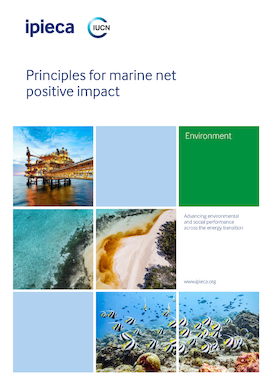
Ipieca and IUCN have launched the Principles for marine net positive impact (NPI), supporting energy companies and other stakeholders seeking to translate voluntary marine net positive impact ambition into credible, measurable and lasting gains for biodiversity and nature.
Developed through extensive engagement and collaboration across the energy industry, the conservation community, governments, academia, finance and other sectors, the principles respond to the distinctive challenges of delivering NPI in dynamic and interconnected marine environments, while recognising that effective action requires scientific evidence, transparency, stakeholder engagement and collaboration.
From ambition to measurable action
The eight principles provide a common foundation for framing, assessing and delivering marine NPI at the project level. They cover:
- Using a seascape approach
- Focusing on priority biodiversity features
- Framing losses and gains through ecological integrity
- Applying the mitigation hierarchy robustly, prioritising avoidance and seeking to avoid offsets
- Assessing residual impacts and identifying contribution to cumulative impacts
- Engaging stakeholders inclusively, proactively, collaboratively and meaningfully
- Prioritising the use of additional conservation actions with measurable outcomes
- Using evidence-led and transparent approach on monitoring, validation and adaptive management
The principles are intended to be applied holistically and to inform organisations’ existing voluntary approaches, rather than provide a step-by-step implementation process. They are built on the Ipieca-IOGP Marine NPI concepts and approaches: literature review, which act as a key supporting resource that may be read in conjunction with these principles.
The principles will be launched during UNCBD COP17 at the IUCN Pavilion on 27 October, 13:30–14:45 (GMT+4), in the Blue Zone, IUCN Pavilion Forum A. During the session, Ipieca members will share case-study examples illustrating how aspects of the principles are being considered in practice, alongside perspectives on opportunities for collaboration and continued learning. Visit the IUCN YouTube channel to watch the livestream