What are biofuels?
Biofuels are renewable energy sources made from organic matter and waste. There are different groups of feedstocks. Crop-based feedstocks can be used for food or fuel (e.g. corn, sugar cane). Non-food energy crops can be intermediate or cover crops and could be grown on degraded land (e.g. camelina, carinata). Another group is that of waste and residue feedstocks (e.g. woody biomass, organic industrial or food waste, used cooking oil), resulting from, for example, agricultural, food or paper industries.
These feedstocks can be used (or converted) to create liquid and gaseous fuels, such as ethanol, biodiesel, renewable diesel, biomethane and sustainable aviation fuel.
Biofuels are different from fossil fuels because they are renewable and can be produced relatively quickly.
How are they used?
Most biofuels are used in the transportation sector to power cars, trucks, ships and aircrafts, with additional applications in farming, industrial equipment and stationary uses such as heating and cooking.
What are the benefits of biofuels to a sustainable energy transition?
Biofuels have the potential to reduce greenhouse gas emissions and offer a low-carbon solution for sectors that are slower-to-decarbonise, such as shipping, heavy-duty transport and aviation.
Biofuels also offer flexibility in that they can be used individually or be blended with traditional fuels, offering an adaptive yet low-carbon solution as the energy transition progresses and support countries with energy security to reduce overall reliance on fossil fuels. The flexibility of blending biofuels also enables compliance with regulatory requirements across different countries and markets.
The definition of what 'sustainable' means can vary in goals, applications and priorities across different frameworks, legislation, guidance or voluntary schemes. In Europe, certification schemes are an important mechanism to allocate sustainability to a biofuel, whereas the US works with so-called 'pathways' for fuels to be considered sustainable.
It is important to note that the sustainability of a biofuel is dependent on its supply chain and the feedstock used for production. This has to do with social and environmental elements, which will be discussed in the next section.
What are social and environmental elements related to biofuels?
Social considerations related to biofuels may include land use and food security, labour rights and working conditions and community impact. Environmentally, examples to consider are land use change in combination with biodiversity, water use, soil health and waste management.
Social and environmental considerations are critical in the supply chain of biofuels to ensure that production and distribution are sustainable. The highest socio-environmental risks are upstream, at the production of feedstocks (regardless of this being a crop or a waste feedstock). For example, deforestation could be the result of increased crop fields for biofuels feedstocks. This would release carbon and have negative effects on biodiversity. In addition, trade-offs sometimes need to be made between food or feed from crop yields and using them for energy. Conversely, the production of feedstocks for biofuels can improve livelihoods for local communities through job creation.
It is important to note that requirements for the production and distribution of biofuels may vary depending on criteria prioritised by different stakeholders or jurisdictions. For that reason, traceability across supply chains is critical in achieving sustainable biofuels.
Find an independent view on social and environmental elements related to biofuels in the Biofuels and biodiversity issues brief, by the International Union for the Conservation of Nature (IUCN).
What is the industry doing to support scale up?
The energy industry is supporting sustainable scale up of biofuels by investing in advanced technologies. For example, waste streams and other non-food feedstocks reduce land use and the competition with food production. Adoption of certification schemes, e.g. the International Sustainability and Carbon Certification (ISCC), the Roundtable on Sustainable Biofuels (RSB), the Roundtable for Sustainable Palm Oil (RSPO), help to ensure traceability and compliance with social and environmental standards.
The energy industry actively supports sustainable government policies (e.g. the EU Renewable Energy Directive) and advocates for policies promoting sustainable practices.
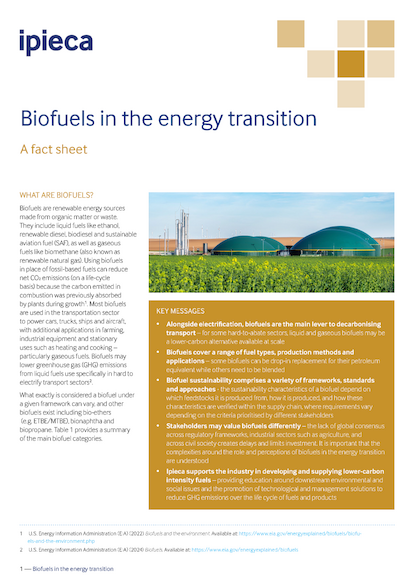
Cross-sectoral collaboration is critical in developing sustainable supply chains. Companies in the energy industry that produce biofuels may work with farmers, regulators, NGOs and local communities to support infrastructure, technology transfer and capacity building.
These efforts aim to balance energy needs with environmental protection and social responsibility.
Member company: Shell and biofuels
For biofuels to be accepted as part of the energy transition, they need to be produced sustainably and lead to significant reductions in carbon dioxide (CO2) emissions. To support this aim, Shell has put strict internal sustainability policies in place to help guide which biofuel feedstocks are purchased. Beyond this, Shell supports the development of more advanced technologies to process feedstocks and transform them into biofuels.
Key takeaways
Biofuels are an important piece of the sustainable energy puzzle. They offer a way to reduce emissions, support rural economies and enhance energy security. There are challenges around the sustainability of biofuels due to varying criteria, frameworks, priorities and policies. Traceability of feedstock supply chains play a critical role in achieving sustainable biofuels.
While there are challenges, the industry is making strides toward more sustainable practices. With ongoing innovation, collaboration and responsible policies, biofuels can help power the transition to a cleaner, more resilient energy future.