Ipieca’s industry leading good practice guidance and resources support oil, gas and alternative energy companies to advance their climate action, environmental responsibility, social performance and integrate sustainability across their operations and supply chains.
The filter below allows you to search for guidance and resources by theme, type, language and date as well as entering a search enquiry.

This compendium from Ipieca and the International Union for Conservation of Nature (IUCN) explores co-use opportunities that optimise land use and infrastructure by combining renewable energy production with other productive activities such as agriculture or nature-based activities.
This 3-part webinar series aims to deepen understanding around the challenges and solutions to the increased demand for mining raw materials for the energy transition, particularly in wind and solar energy projects.
This document provides a comprehensive review of existing good practices that address environmental and social risks across the supply chain, and carbon footprint management across the project life cycle of onshore and offshore wind and solar PV technologies.
An update to the compendium, first published in 2020, is now available. It aims to support renewable energy developers to enhance the environmental and social performance of their projects and operations.
Guidance to support practitioners in developing robust social baselines for offshore project impacts to fisheries.
Promotion and certification of sustainable biofuels is complex and requires a well coordinated, multi-faceted and credible approach, and includes compliance with government mandates, international standards and certification programmes, which will be instrumental in promoting the responsible production of sustainable biofuels. This guide provides an introduction to biofuels Chain of Custody (CoC) systems as well as providing information on the different types of CoC systems in use.

This webinar provides a comprehensive overview of what the new compendium covers, as well as a virtual stakeholder panel session featuring key stakeholders who contributed to its development, whom will discuss enablers, barriers and the business case for co-use.
This fact sheet explores key aspects of biofuels and explains the role of biofuels in the energy transition, outlining the main biofuel types, feedstocks and production pathways, as well as where and how biofuels are used across transport and other sectors. It also describes how biofuel sustainability is assessed.

The annual Ipieca sustainability reporting survey identifies trends in the sustainability reporting practices of Ipieca member companies. These are the results for 2025.

This webinar shares the essential steps in producing a sustainability report for oil and gas companies, providing guidance on the necessary processes, requirements, and best practices in the industry.

Ipieca, API, IOGP and Arpel hosted three webinars for companies in the Latin America region to support companies along their sustainability reporting journey. Learn about why sustainability reporting matters and how to produce a report.
A framework to help companies shape the structure and content of their sustainability reporting, including for companies starting to report.
This is the fourth progress report, highlighting how Ipieca and its members are implementing the Ipieca-WBCSD SDG Roadmap.

To launch its new worker welfare resources, Ipieca hosted a webinar with key stakeholders to highlight tools and share implementation case-studies that the audience can learn from.

This resource provides definitions, and a summary of key tools and guidance produced by selected external stakeholders on responsible recruitment and proactive worker engagement. It is intended to be shared with energy companies’ suppliers, clients, and partners to promote the convergence of industry definitions and good practices on these two topics.

This interactive dashboard presents highlights from the latest Ipieca sustainability reporting survey, as well as analysis of all survey results since 2012, allowing for year-on-year comparisons which highlight reporting trends and changing priorities across the industry.

This interactive dashboard presents highlights from the latest Ipieca sustainability reporting survey, as well as analysis of all survey results since 2012, allowing for year-on-year comparisons which highlight reporting trends and changing priorities across the industry.

The annual Ipieca sustainability reporting survey identifies trends in the sustainability reporting practices of Ipieca member companies. These are the results for 2024.
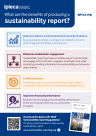
What are the benefits of producing a sustainability report? This infographic highlights four key benefits.

Ipieca is pleased to sponsor the re-launch of the Energy Local Content Map, which provides access to local content legislation, news and studies for over 30 countries around the world. Please join one of the two webinars by the Mining Shared Value programme of Engineers Without Borders Canada, to gain insights into the latest updates and features of the map and to learn about local content trends presented by guest speakers.

The Energy Local Content Map compiles key information pertaining to local content in the extractive industries, organized by country.
This is the third progress report, highlighting how Ipieca and its members are implementing the Ipieca-WBCSD SDG Roadmap.

The annual Ipieca sustainability reporting survey identifies trends in the sustainability reporting practices of Ipieca member companies. These are the results for 2023.

Ipieca is pleased to launch its labour rights training, developed with the contribution of Building Responsibly and hosted on the Supply Chain Sustainability School’s e-learning platform.
This report provides an overview of key messages from the two stakeholder panels exploring how Ipieca can support its members to lead the industry’s contribution to a sustainable energy transition, and how Ipieca can provide a trusted/safe channel for dialogue and collaboration with key stakeholders.
This panel session compared the opportunities and challenges of initiatives from the International Sustainability Standards Board (ISSB), the US Securities Exchange Commission (SEC) and the European Financial Reporting Advisory Group (EFRAG).

Twelve e-learning modules to support the industry and its supply chain to improve awareness and management of labour rights issues.
The Ipieca-WBCSD SDG Roadmap is designed to be implemented. Ipieca produces annual reports to demonstrate progress and assess where gaps are, sharing concrete examples from companies and Ipieca.

The annual Ipieca sustainability reporting survey identifies trends in the sustainability reporting practices of Ipieca member companies. These are the results for 2022.
Marking over a year since its launch, we highlight some of the progress Ipieca has made towards implementing the SDG Roadmap.

Ipieca has launched the Supply chain library of questions and resources and will be hosting a webinar to introduce the tool and provide a demonstration on how to utilise it most effectively.

The annual Ipieca sustainability reporting survey identifies trends in the sustainability reporting practices of Ipieca member companies. These are the results for 2021.


