Ipieca’s industry leading good practice guidance and resources support oil, gas and alternative energy companies to advance their climate action, environmental responsibility, social performance and integrate sustainability across their operations and supply chains.
The filter below allows you to search for guidance and resources by theme, type, language and date as well as entering a search enquiry.
A framework to help companies shape the structure and content of their sustainability reporting, including for companies starting to report.

The annual Ipieca sustainability reporting survey identifies trends in the sustainability reporting practices of Ipieca member companies. These are the results for 2025.

The annual Ipieca sustainability reporting survey identifies trends in the sustainability reporting practices of Ipieca member companies. These are the results for 2024.

The annual Ipieca sustainability reporting survey identifies trends in the sustainability reporting practices of Ipieca member companies. These are the results for 2023.

The annual Ipieca sustainability reporting survey identifies trends in the sustainability reporting practices of Ipieca member companies. These are the results for 2022.

The annual Ipieca sustainability reporting survey identifies trends in the sustainability reporting practices of Ipieca member companies. These are the results for 2021.
The results of Ipieca's annual Sustainability reporting survey are now available.
The 2019 results of Ipieca's annual Sustainability reporting survey are now available.
The survey is designed to assess the sustainability reporting practices of oil and gas companies...

This webinar shares the essential steps in producing a sustainability report for oil and gas companies, providing guidance on the necessary processes, requirements, and best practices in the industry.

Ipieca, API, IOGP and Arpel hosted three webinars for companies in the Latin America region to support companies along their sustainability reporting journey. Learn about why sustainability reporting matters and how to produce a report.

This interactive dashboard presents highlights from the latest Ipieca sustainability reporting survey, as well as analysis of all survey results since 2012, allowing for year-on-year comparisons which highlight reporting trends and changing priorities across the industry.

This interactive dashboard presents highlights from the latest Ipieca sustainability reporting survey, as well as analysis of all survey results since 2012, allowing for year-on-year comparisons which highlight reporting trends and changing priorities across the industry.
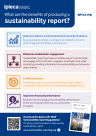
What are the benefits of producing a sustainability report? This infographic highlights four key benefits.
This panel session compared the opportunities and challenges of initiatives from the International Sustainability Standards Board (ISSB), the US Securities Exchange Commission (SEC) and the European Financial Reporting Advisory Group (EFRAG).
SPE Gaia and SPE CCUS Technical Section, IOGP, OGCI and Ipieca, are hosting a webinar series sharing knowledge and good practice around the scaling up of CCS technology, including key issues, environmental responsibility, financial incentives, policy, and liability concerns.

This webinar focuses on the World Bank GFMR's 2026 Global gas flaring tracker report. It highlights recent updates to the tracker’s methodology, which aims to improve the accuracy and consistency of global gas flaring estimates, as well as an overview of the GFMR 2025 annual progress report.
This report from Ipieca-Energy Institute-CIRIA helps companies integrate circular economy principles into every stage of an asset’s life cycle. It provides practical guidance, tools and examples to support the transition from linear approaches to more circular, resource-efficient ways of designing, building, operating and decommissioning assets.
During Ipieca Week 2026, Ipieca stakeholders were invited to provide insights on the global energy system's profound transformation.
During Ipieca Week 2026, Ipieca stakeholders were invited to provide insights on the complex and interconnected development realities of Global South countries as they pursue economic and social progress while aiming to meet climate and nature goals.

Covering a range of topics on sustainable financing and derisking investments across the full value chain—from capture to transport and storage.

The theme of this Annual Review reflects the strategic intent introduced in Ipieca’s 2025-2028 Strategy, which aims to accelerate action underpinned by collaboration
and shared understanding across the UN, business, finance and civil society.
This fact sheet explores key aspects of biofuels and explains the role of biofuels in the energy transition, outlining the main biofuel types, feedstocks and production pathways, as well as where and how biofuels are used across transport and other sectors. It also describes how biofuel sustainability is assessed.

This webinar offers a range of perspectives around permitting to development for CCS, including but not limited to, topics such as experiences in permitting, discussions around social acceptance, long-term liability, jurisdictional differences and lessons learned.
This second edition provides an updated overview of key concepts, definitions and priorities informing the just transition landscape.

The 'Plastic pellets clean-up field guide' provides practical, operational guidance to support safe and effective recovery following a marine or coastal plastic pellets incident.
A technical support document to accompany the Ipieca-IOGP guidance on surface and subsurface dispersant
Ipieca, in partnership with Arpel, ACP and AMEXHI, and supported by IOGP and OGDC, held a series of three webinars for the Latin American region focused on methane emissions.

Responding to the continuous advancement of technology, Ipieca, IOGP, OGCI, and the Energy Institute have released an update of this guidance and online tool to help operators select and deploy methane detection and quantification technologies.

This webinar focuses on the World Bank Global Flaring and Methane Reduction Partnership’s (GFMR) recently launched '2025 Global gas flaring tracker report', with special insights and key takeaways from our speakers.

This webinar provides a comprehensive overview of the updated Compendium and will showcase how industry peers are already utilising the document to action real energy efficiency improvements within their operations.

This webinar provides a comprehensive overview of what the new compendium covers, as well as a virtual stakeholder panel session featuring key stakeholders who contributed to its development, whom will discuss enablers, barriers and the business case for co-use.


